Insight and comment for AML Compliance

Keeping law firms prepared for AML reviews
Many legal and accounting firms are under-prepared for AML Compliance reviews because their processes are inconsistent and often spread across emails, folders and spreadsheets. This can waste a significant amount of time.
A greater issue is the tendency to complete AML compliance on a ‘when I can’ basis, but it does not need to be like that. It is advisable to use a more systematic process to obtain client information in an automated manner (where possible), complete due diligence in line with Law Society or CCAB guidelines and deliver a client due diligence report for each review event.
The key to saving time is to navigate AML due diligence requirements effectively, addressing the relevant risk profile of each individual client, and not getting tied down in detailed risk considerations that are not relevant to that particular client. Due diligence on your low risk clients should be completed in minutes.
AML Manager is designed for Accounting, Legal and Real Estate firms. It provides a systematic AML process and takes you through the appropriate risk analysis for each client. It saves valuable time. Could this work for your firm?
Keeping a structured approach to your AML compliance
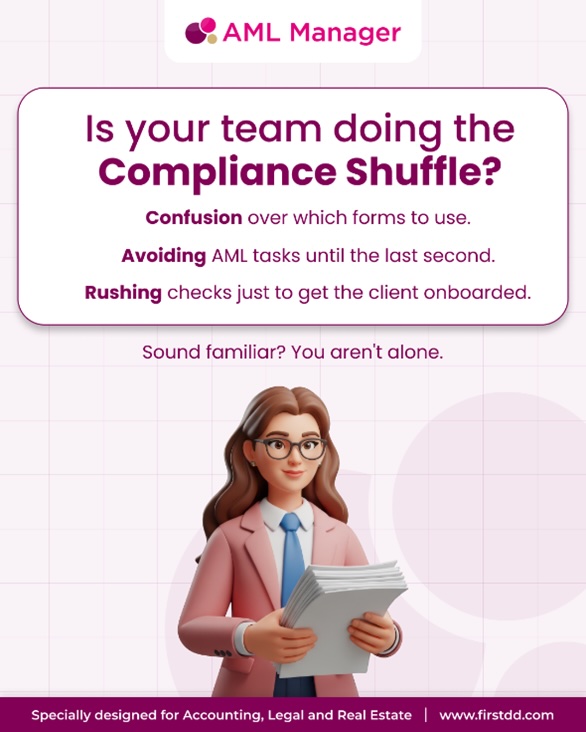
Many firms can recognise a pattern that quietly develops around AML compliance.
Different departments or individuals do their AML due diligence in slightly different ways, and the firm generally is shuffling their compliance. The route to compliance is often inconsistent and disjointed, and results in firms not really knowing how they stand. This can cause stress and lose a significant amount of time before a regulatory review.
Additionally, documents and risk assessments can be stored in separate locations and it becomes harder to demonstrate that the same standards have been applied across all clients.
A structured process removes that uncertainty. AML Manager is designed for Accounting, Legal and Real Estate firms. It provides a clear and automated workflow to collect client information, complete due diligence and risk assessments, and stores the supporting evidence in one organised place.
The firm has visibility of AML compliance across the whole client base and can identify who may need additional administrative support. AML Manager acts as your ‘system of record’ and saves professionals a significant amount of time.
Is it time to avoid the shuffle and be confident that your firm is compliant?
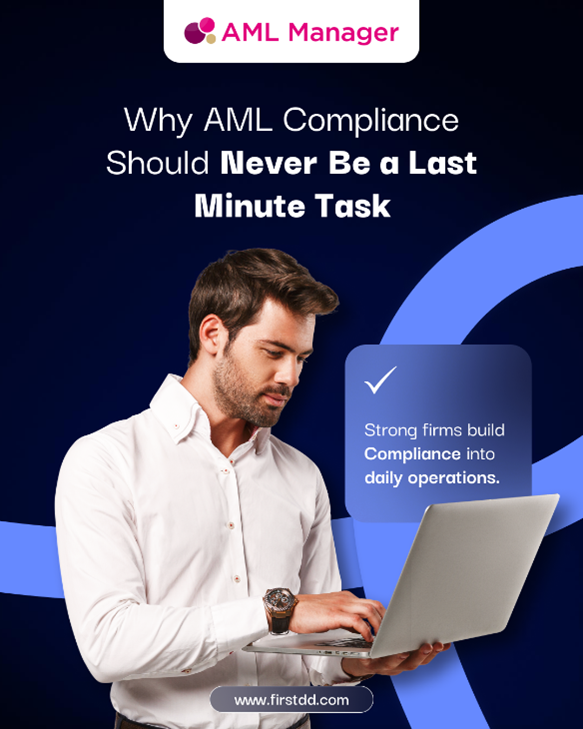
Last minute’ AML compliance can cost a business in many ways.
The timing of an AML due diligence process is key to compliance. It must be completed prior to doing business, when the client is undertaking significant activities and by default on a periodic basis of no more than five years. Failure to produce a record of these activities will result in non-compliance.
Relying upon a ‘last minute’ push to get your AML compliance in order prior to an inspection is also very time consuming. Firms often spend valuable time trying to confirm what was completed, where evidence was saved and whether the risk decision was properly recorded. These events have been known to distract key personnel for days, losing time and revenue.
And this lack of co-ordination can be generally distracting and de-motivating for all staff involved.
Strong firms build compliance into daily operations, so the evidence is created as the work is done, not reconstructed later. It is advisable to have a structured and easily understood AML compliance process that enables all staff to play their part and complete your AML compliance in timely and technically correct manner.
If you feel that your AML compliance still feels like a last minute task, AML Manager can help you manage it properly. AML Manager is a software process designed for Accounting, Legal and Real Estate firms that want a clear and structured process to manage their due diligence. Contact us now for a confidential consultation and demonstration.

Questions Every Firm Should Ask About Their AML Process
𝟏. 𝐀𝐦 𝐈 𝐀𝐌𝐋 𝐂𝐨𝐦𝐩𝐥𝐢𝐚𝐧𝐭?
Being compliant is not simply about completing AML checks at onboarding. Firms need a consistent process that records risk assessments, identification checks and ongoing monitoring clearly over time. The real test is whether the firm can demonstrate that process during a practice review.
𝟐. 𝐀𝐦 𝐈 𝐝𝐨𝐢𝐧𝐠 𝐭𝐡𝐞 𝐫𝐢𝐠𝐡𝐭 𝐝𝐮𝐞 𝐝𝐢𝐥𝐢𝐠𝐞𝐧𝐜𝐞 𝐟𝐨𝐫 𝐞𝐚𝐜𝐡 𝐜𝐥𝐢𝐞𝐧𝐭?
Not every client requires the same level of due diligence. Low-risk clients and higher-risk matters require different approaches. A structured AML process helps ensure the correct level of due diligence is applied consistently and properly recorded for every client relationship.
𝟑. 𝐂𝐚𝐧 𝐈 𝐝𝐞𝐦𝐨𝐧𝐬𝐭𝐫𝐚𝐭𝐞 𝐝𝐮𝐞 𝐝𝐢𝐥𝐢𝐠𝐞𝐧𝐜𝐞?
Completing AML checks is only part of the process. Firms must also be able to evidence what was completed, when it was completed and who carried it out. Without organised records, demonstrating due diligence during a practice review becomes far more difficult and time-consuming.
𝟒. 𝐈𝐬 𝐀𝐌𝐋 𝐰𝐚𝐬𝐭𝐢𝐧𝐠 𝐭𝐨𝐨 𝐦𝐮𝐜𝐡 𝐭𝐢𝐦𝐞?
AML compliance can become inefficient when information is spread across multiple systems, folders and manual processes. Staff spend valuable time chasing documents, updating spreadsheets and checking incomplete records. A structured system reduces administration and keeps the process organised.
𝟓. 𝐈𝐬 𝐢𝐭 𝐰𝐨𝐫𝐭𝐡𝐰𝐡𝐢𝐥𝐞 𝐜𝐡𝐚𝐧𝐠𝐢𝐧𝐠 𝐭𝐨 𝐀𝐌𝐋 𝐌𝐚𝐧𝐚𝐠𝐞𝐫?
Many firms continue using processes that create unnecessary administrative work simply because “it is how things have always been done”. AML Manager provides a clear and organised process that helps firms save time, maintain consistent records and demonstrate AML compliance with confidence.